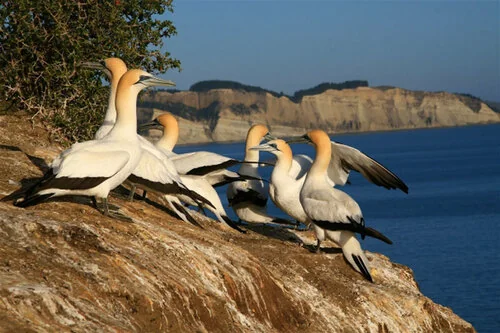
Cape Kidnappers
A relaxed drive from Ahuriri
Cape Kidnappers/Te Kauwae-a-Māui holds one of the world's largest mainland colonies of Australasian gannets. The best viewing season runs from October to April. Access is either via a tide-dependent 19 km beach walk from Clifton, or by guided overland tours across private farmland — the safer and more common choice for visitors.
The place and its name
Cape Kidnappers/Te Kauwae-a-Māui juts into the Pacific at the southern end of Hawke's Bay. The Māori name translates as the jawbone of Māui, the legendary navigator who fished the North Island from the sea. The cape is reached by driving south from Napier along the coast to Clifton, a small settlement where the road ends and the reserve begins.
The landscape en route is geology made legible. The cliffs along the beach route read in layered bands of cream, grey, and rust — sandstone, mudstone, conglomerates, and river gravels laid down over millennia. Around Black Reef, the rock shelves show fossil shells and exposed lignite where the sea has undercut the base. It is striking country before you reach the birds.
The gannet colony
From early November to late February, the plateau colony at the cape supports thousands of Australasian gannets — one of the largest accessible mainland colonies in the world. The birds nest on open ground at close quarters, largely unfazed by observers. Adults with golden heads and pale blue eyes defend small territories at pecking distance from their neighbours, and the air above the colony is in constant motion as birds depart and return from feeding runs over the ocean. Chick-rearing is well advanced by mid-summer, and the colony begins to disperse as autumn arrives.
Getting there: the beach walk
The Department of Conservation beach route runs approximately 19 kilometres return from Clifton. The going is mostly flat but not trivial — sections of soft sand, stream crossings, and occasional boulder scrambling around headlands. The route passes directly beneath unstable sandstone and mudstone cliffs. DOC's advice is explicit about the risk: the hazard profile is comparable to mountaineering, and slips can occur without warning. The walk is only safely undertaken around low tide within specific windows. Tide times must be checked before departure. This is a committing day out, not a casual stroll.
The overland tours
Commercial operators run tractor-drawn tours and 4WD vehicles across the private farmland to the plateau, bypassing the beach route entirely. These tours deliver guests to the colony with commentary and scheduled viewing time and are well suited to families, those wary of the rockfall risk, or anyone who wants a structured half-day. Overland tours must be booked directly with licensed operators. Access to the plateau crosses private land; the DOC reserve and the farm operation are separate.
When to visit
The main colony season runs October through April, with November to February the peak for viewing nesting adults and growing chicks. Outside that window, the reserve is generally quieter and less active. The cape is a full-day commitment however you approach it — allow time for the drive, the experience, and the return journey. Hot days reflect strongly off pale cliffs and sand, so sun protection is worth planning for.
Safety and access logistics
If walking the DOC beach route, tide information is essential and is available from DOC and standard NZ tide sources before departure. The overland commercial tours manage this for you, departing at set times that align with suitable conditions. Dogs are not appropriate on the DOC beach route or at the gannet colonies due to wildlife protection requirements. Private vehicles are not permitted on the private farm tracks that lead to the plateau colony — the overland experience requires booking with a licensed operator. The golf course at the cape is a separate, private operation; it is not part of the DOC reserve and has no connection to gannet colony access.