Te Mata Peak
A relaxed drive from Ahuriri
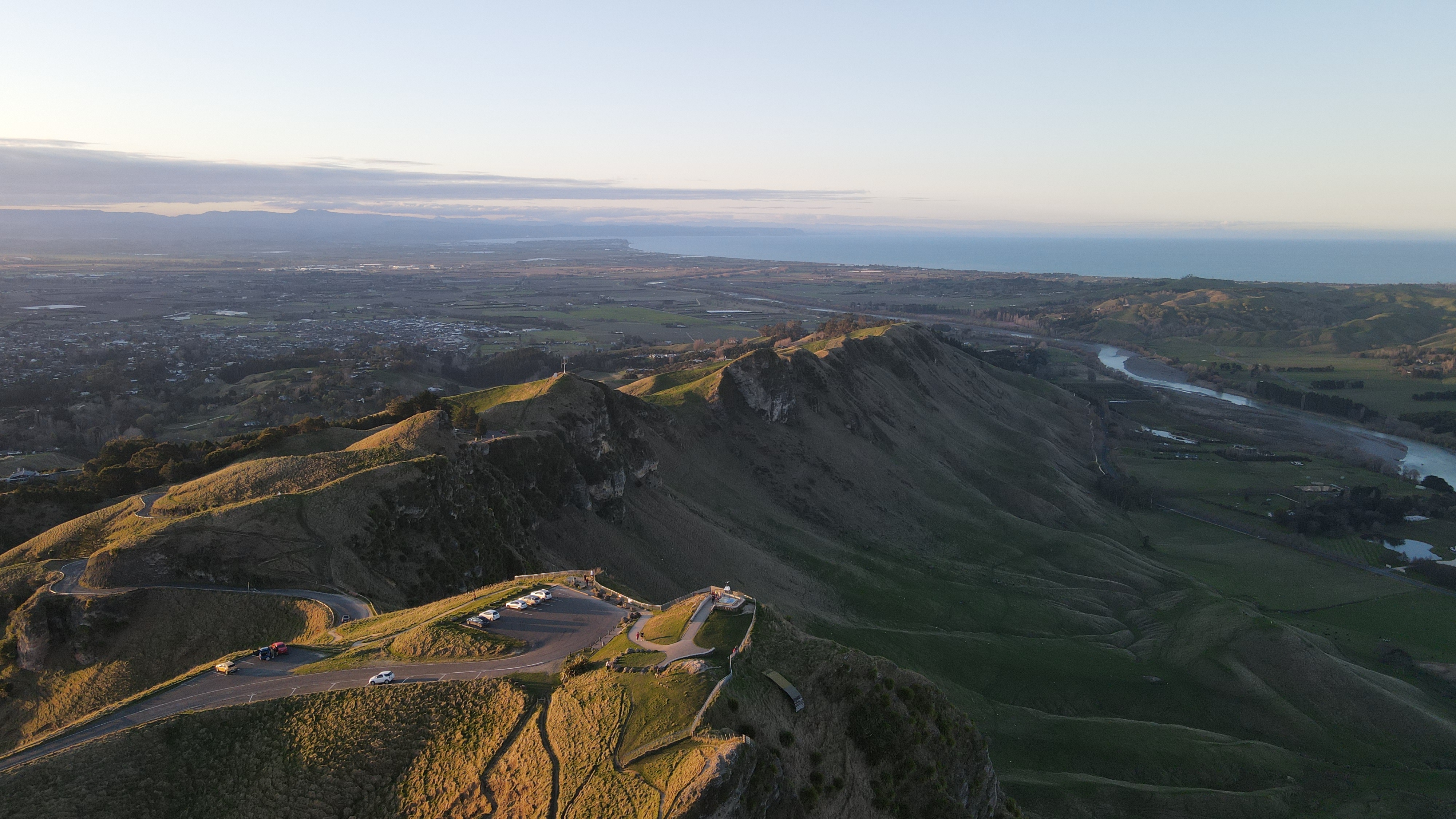
Te Mata Peak rises to 399 metres above the Heretaunga Plains, offering sweeping views across Hawke's Bay vineyards, the Tukituki River, and the Pacific coastline. The summit is reachable by car via a sealed road, or on foot via walking tracks through redwood groves and open ridgelines. The peak carries the Māori name Te Mata-o-Rongokako, the legend of a giant whose form shapes the skyline.
The legend behind the skyline
Te Mata-o-Rongokako — the face of Rongokako — is the Māori name for the peak, and it refers to the legendary giant whose body, in one account, formed the hills after he choked attempting to bite through the land as a test of devotion. The distinctive "bite" out of the eastern cliff face is visible from the plains and gives the silhouette the quality of narrative. The peak is sometimes called the Sleeping Giant by European settlers who saw a reclining human form in the ridgeline. Knowing either story does not change the physical experience, but it gives a different texture to the landscape — the sense that these contours have been read for a very long time.
The view from the top
At 399 metres, the summit lookout is one of the best elevated viewpoints in the region. The Heretaunga Plains spread below in a patchwork of orchards, vineyards, towns, and the Tukituki River valley. On clear days the Pacific coast is sharp in both directions, and Māhia Peninsula is visible to the north. The plains are so flat and the peak so prominent that the contrast in scale is immediately striking — the sense of suddenly being above the entire agricultural landscape you have been moving through.
The summit car park is at the top of a sealed but winding road from Havelock North. Reaching it by car takes the elevation gain out of the equation and makes the view accessible regardless of fitness level. There are no cafes or water at the summit — provisions are worth bringing from Havelock North before the ascent.
Walking and cycling the park
Te Mata Park covers around 99 hectares and offers a network of walking and mountain biking tracks ranging from short lookout circuits to longer routes that gain and lose significant elevation. The Rongokako trail climbs steadily along the ridge to the summit; the Giant circuit takes a longer loop. A grove of Californian redwoods planted in 1927 provides a section of sheltered, cool walking that feels completely different from the exposed limestone ridgelines — the air drops several degrees, the ground softens with fallen needles, and the scale of the trees changes the spatial quality entirely.
Track surfaces vary: well-formed in most places, but uneven and potentially slippery in wet conditions when clay and limestone combine. Decent footwear is worth having for anything beyond the summit car park. Facilities are available at the main gates entrance; the summit itself has none.
Conservation work in the park
Te Mata Park Trust manages the parkland and has been running ongoing planting programmes to restore native biodiversity across slopes affected by storm damage and erosion. The park was gifted to the public in 1927 for recreation and conservation, and its current character reflects nearly a century of that dual purpose — maintained for walkers and cyclists while also being actively managed for ecological recovery.
The park is generally free to enter with no admission charge. Dogs are permitted with conditions that vary by track; check current park rules before bringing pets. No facilities are available at the summit — toilets are at the main gates car park, and there are no food or water sources above that point. Visitors heading up for a walk should carry what they need before leaving the car park.
Pairing with wineries
Te Mata Peak sits directly above the Tukituki River valley, and Craggy Range winery is visible at the base of the escarpment. The combination of the peak and a vineyard lunch in its shadow is a natural half-day itinerary — go early for the views before the heat builds, then descend to Havelock North or the valley floor for the afternoon. Early morning or late afternoon light makes the landscape more photogenic and the summit less exposed to wind and midday glare.